
When a business reaches the point where growth needs to become more deliberate, it needs to make clearer marketing decisions.
The instinct is to invest in more activity: refresh the website, post more consistently, run a campaign, create new collateral, or bring in a supplier who can start moving things forward.
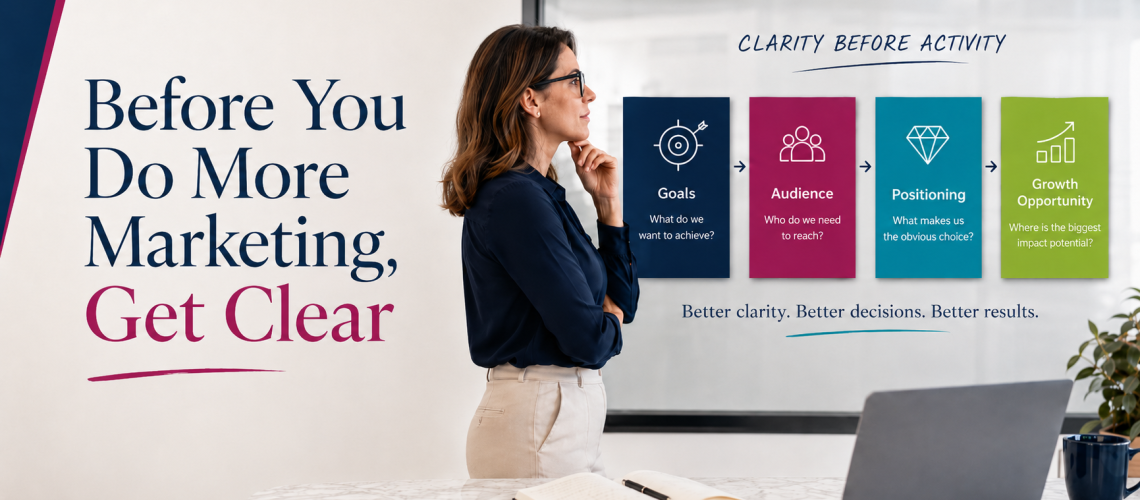
Those actions may all be needed, but they are usually the wrong starting point. Before the business decides what to do, it needs to be clear on the marketing decisions that will make the activity worth doing: what marketing must achieve, who it needs to influence, what the business should be known for and where the strongest opportunity sits.
These four questions help businesses make better marketing decisions and bring greater focus to their next move.
1. What does the business need marketing to achieve?
Marketing should be directly connected to the business strategy and objectives.
That sounds obvious, but this is often where the gap begins. A business may know that marketing needs more attention, but still be unclear on the commercial role it needs to play.
Is the priority to support sales, build credibility in a specific market, improve conversion, strengthen referrals, grow existing client relationships, enter a new sector, launch a new offering, or create a more consistent pipeline?
Each objective requires a different approach. The clearer the business is on the role marketing needs to play, the easier it becomes to make better marketing decisions about what to prioritise and what to leave for later.
The key question to ask: What would need to be different in the business 12 months from now for marketing to have done its job?
2. Who are we trying to reach and influence?
Many businesses describe their audience in general terms: decision-makers, corporates, SMEs, business owners, or anyone who needs the service. These descriptions may be technically correct, but they are rarely specific enough to guide strong marketing decisions.
A useful marketing strategy goes deeper. It identifies who the business needs to reach, what those people care about, what triggers their need, what they may be comparing, and who else influences the decision.
This is especially important in B2B businesses, where the person who notices the business, the person who engages, the person who recommends and the person who signs off may not be the same person.
When the audience is clearer, the message becomes more relevant, the channel choices become more deliberate and the sales process is better supported.
The key question to ask: Who needs to understand, trust, or recommend us before a decision can move forward?
3. What do we want to be known for?
A business can be capable, credible and experienced, but still not be clearly understood by the market. It is also one of the most important marketing decisions a growing business needs to make.
Positioning is not only about sounding different. It is about helping the right people understand what the business does best, where it creates value, why it is credible and why it should be chosen over another option.
For many growing businesses, the way the business presents itself does not fully reflect what it has become. The team may have grown, the offering may have evolved, the client base may have changed, or the work may have become more sophisticated, but the message has not caught up.
When that happens, too much pressure sits in the sales conversation. The business has to keep explaining its value instead of allowing the website, collateral, content and market presence to do more of that work earlier.
A clear strategy helps define what the business should be known for and how that value should be communicated consistently.
The key question to ask: If a prospect remembered only one thing about our business, what should it be?
4. Where is the strongest growth opportunity?
The next marketing move should not only be based on what is missing. It should be based on where marketing can create the most value.
For some businesses, the strongest opportunity may be better visibility in a specific market. For others, it may be more intentional communication with existing clients, stronger referral support, clearer packaging of services, better sales collateral, thought leadership, sector focus, or a stronger digital presence.
This is where marketing can become too tactical too quickly. The business chooses an activity before fully understanding the opportunity it is trying to unlock.
A stronger approach starts by identifying where growth is most likely to come from and what needs to be in place to support it. That may mean attracting new prospects, but it may also mean helping existing clients understand more of the offer, giving sales stronger tools, improving conversion, or making the business easier to refer. The opportunity should shape the activity and guide the marketing decisions that follow, not the other way around.
The key question to ask: Where is there already potential for growth that marketing could help us unlock more deliberately?
Make The Next Marketing Move a Strategic One
Marketing does not need to become more complicated as the business grows, but it does need to become more deliberate. That is where Brightside Marketing helps.
We work with growth-stage businesses to assess the current position, identify the gaps and opportunities, and develop a practical brand and marketing strategy that gives the business a clearer way forward.
The result is not a strategy for the sake of strategy. It is a focused plan that helps the business make better marketing decisions, align efforts to growth and move into execution with more confidence.